Wednesday, 18 January 2017

Memorial to John Ireland of Burnchurch, 1st Archbishop of St.Paul, Minnesota.

There is a distinctive roadside memorial at the farm opposite Burnchurch Tower.   It is a large 10 foot Celtic Cross, set back a bit from the road but enclosed within a railed area and encircled by a cut stone wall.  It reads "Sacred to the memory of John Ireland, First Archbishop of St Paul, Minnesota, USA,  Suaimhneas soirai da anam".  This Celtic Cross is a replica of the memorial placed over the Archbishop's grave in St Paul and was made by a monumental sculptor in St Paul and shipped to Ireland early in 1966.  This memorial was formerly unveiled at Burnchurch on 18th September 1966.
On a separate placque up on the wall surrounding the Celtic Cross is the following inscription " John Ireland 1838-1918, Patriot, Statesman, Priest of Christ.  His soul has gone out into all lands and his fame until the ends of the earth.   Suaimhneas siorai da anam" (Eternal Peace to his Soul).


John Ireland was born at Burnchurch, Parish of Danesfort,  county Kilkenny on 11th September 1838.


His parents were Richard Ireland, a carpenter by trade and Judith Naughton, Richard's second wife  Richard Ireland worked as a carpenter for the Flood family.  In the 1960s workmen carrying out repairs to Farmley House, the Flood home, discovered amongst other names, the name of Richard Ireland inscribed in the lead roof lap.
The children of this marriage, all in the Danesfort Register as being from Burnchurch are:-
1. Ellen baptised 30 November 1836. Sponsors: Garret Fleming and Atty Naughton (died young)
2. John baptised 11 September 1838. Sponsors: John Nougthon and Mary Marnell.
3. Richard baptised 29 Nov 1840, Sponsors: Richard Shirly and Catherine Kenehan (died young).
4. Ellen baptised 1 July 1842. Sponsors: Thomas McCabe and Mary Northon (Naughton).
5. Bess(Eliza) baptised 7th August 1844. Sponsors: Edmond Carty and Cath Marnell.
6. Richard baptised 23 Nov 1847. Sponsors: David Carty and Margaret Ryan.
7. Johanna baptised 7 August 1849. Sponsors: Thomas Rice and Honora Naughton.
Both Ellen (Mother Seraphine) and Eliza (Mother St John) entered the Community of the Sisters of St. Joseph of  Carondelet and were still alive in 1918.   In addition Richard Ireland had a daughter Mary Anne by his first wife whose name is unknown.
Richard Ireland left Kilkenny in 1849 to seek a better life in America; he was accompanied by his sister Nancy.   He initially settled in Burlington, Vermont before sending for his wife and children to join him in 1850.  In 1852 Richard decided to move the whole family to Minnesota and they arrived in St Paul in May of that year.
By this time the young John Ireland, highly intelligent and extremely pious, was showing signs of a religious vocation.  He was selected as a suitable candidate to be educated, free of charge, for the priesthood and he was sent to a seminary in Meximieux in France.  When John Ireland returned to St Paul in 1861 he was ordained as a priest at the early age of only 23 yr.  His rise within the Church was rapid.  In 1875 at only 37 he was ordained as a Bishop and in 1888, aged 49 yrs, he was appointed first Roman Catholic Archbishop of St Paul, Minnesota.    He was a priest for approximately 56 years and a Bishop for 44 years.
As a young priest he volunteered and served as Chaplain in the 5th Minnesota Volunteer Infantry during the American Civil War.  He proved popular with the men but exhausted his health with his pastoral duties, some on the battlefield.  A keen chess player, as Chaplain, he always carried with him a set of miniature chess men and a rubber blanket chess board and made a point of playing chess with the soldiers.
Archbishop Ireland had a strong and charismatic personality. He rose to be a leading civil and religious leader; his liberal views gave him a wide reputation and influence outside the Church and he worked closely with non-Catholics.  He was employed on diplomatic missions by both the Pope and the President of the United States and was on intimate terns with Presidents William McKinley, Theodore Roosevelt and William H. Taft.  In 1902 he represented President McKinley and the American people at the unveiling of a memorial in Paris, France, to the French revolutionary soldier and politician Layfayette.
Disturbed by reports of the poor social and economic conditions of the Irish immigrants crowding into the urban slums along the eastern seaboard, he was instrumental in founding the Catholic Colonisation Bureau of Minnesota.  This organisation bought good farm land, more than 400,000 acres, in rural areas only recently cleared of its native Sioux in the Dakota War of 1862.   Between 1876 and 1881, working with the railroads and the Minnesota State Government, he organised and directed the most successful rural colonisation programme bringing out more than 4000 Irish Catholic families from the slums in the east and settling them on farm land in Minnesota.  The scheme whilst highly successful did have one failure.  He organised for over 300 Gaelic speaking immigrants to be brought direct from Connemara to Minnesota.  These immigrants unfortunately knew nothing about farming, had no English and were ill prepared for life on the American prairie, especially during the severe winter of 1880 and this particular venture was not successful but otherwise this was a highly successful scheme for the betterment of poor immigrants.
Archbishop Ireland was especially keen to develop education and sought to harmonise Catholicism with American institutions. He founded the College (now University) of St Thomas in 1885, the Saint Thomas Academy and the St Paul Seminary.  In 1889 he also helped establish the Catholic University of America.
He died in St Paul on 25th September 1918 and was buried in the Calvary cemetery, St Paul, Minnesota.    Before he died he burnt all his personal papers.
His was a life of outstanding achievement and industry.   One of the Archbishop's sayings was "Pessimism is the devil's art".   Obviously he himself was an optimist and a proud son of county Kilkenny.   There is a well written and researched book  "The Life and Times of Archbishop John Ireland" written by Monsignor James H Moynihan, published in 1955 by Harper, New York.  
See also The Old Kilkenny Review 1967  Archbishop John Ireland.  (Pages 64-68).

Tuesday, 10 January 2017

Burnchurch Graveyard, Parish of Danesfort, co Kilkenny

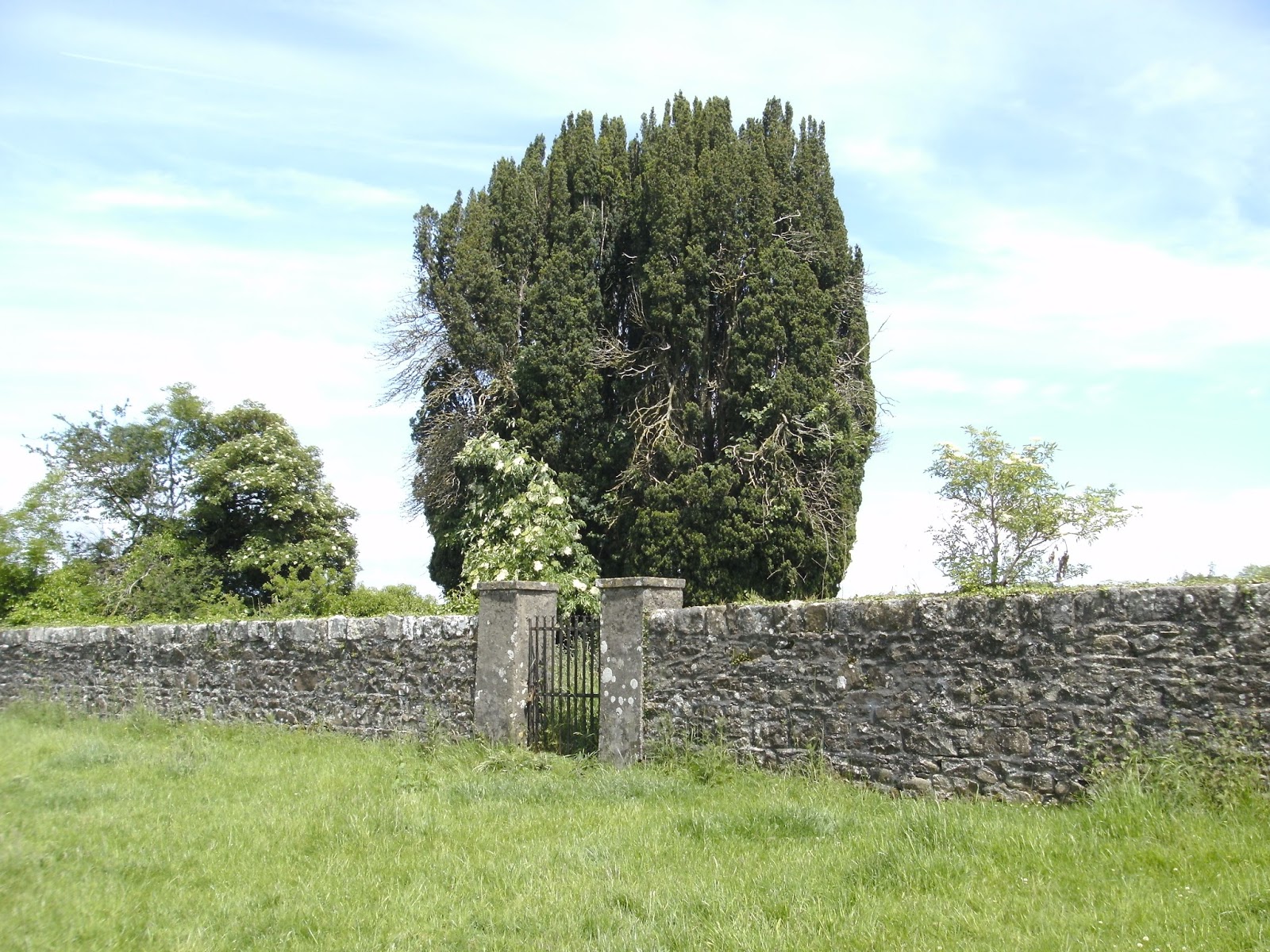
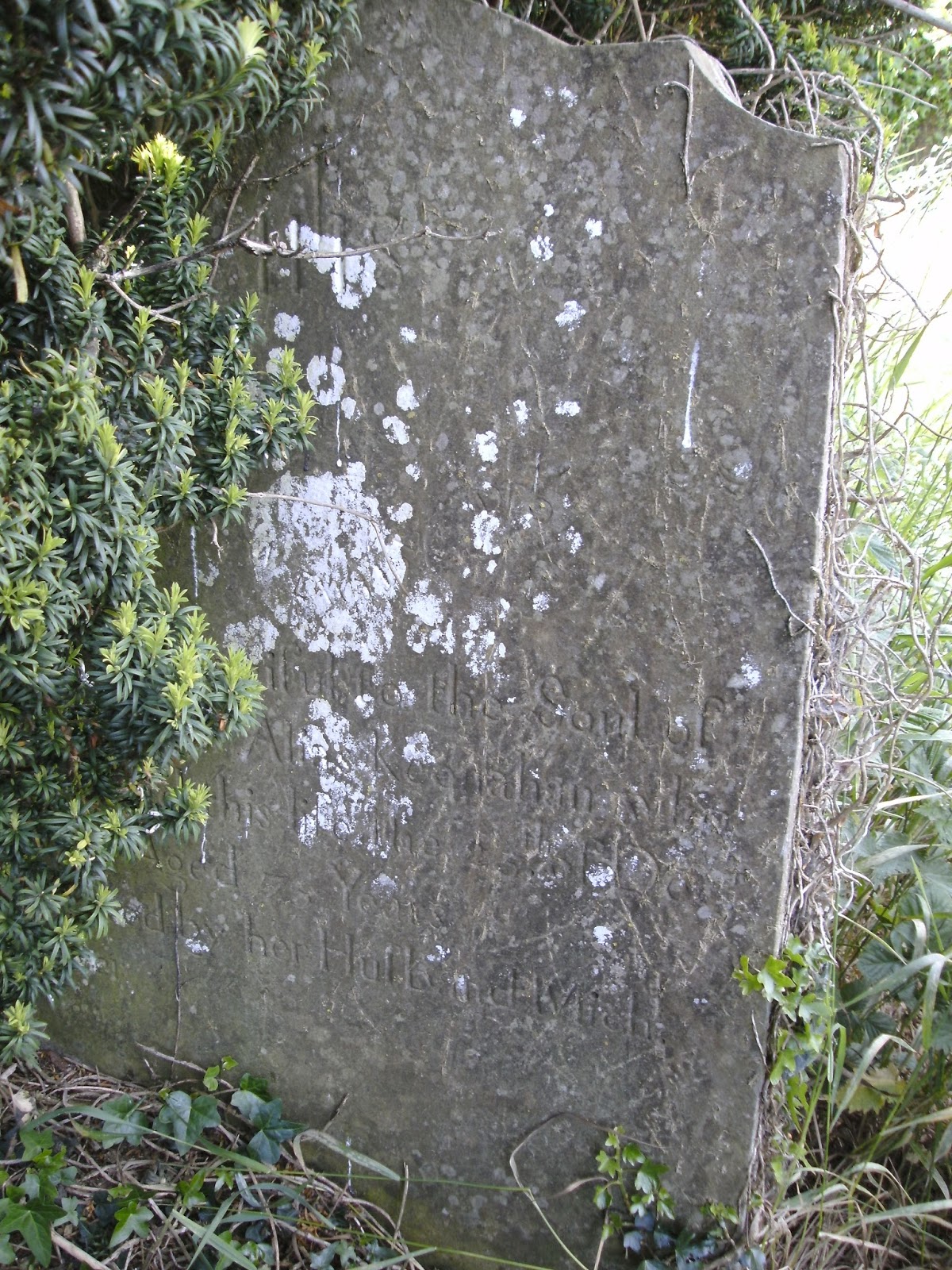
Burnchurch graveyard, and nearby ruined tower house, is one of the unsung glories of rural county Kilkenny.  This beautiful walled graveyard contains both Church of Ireland and Catholic burials and is of historical interest.   It is a very ancient burial place with memorials dating from the 15th century. Apart from these very early memorials of obvious historical interest there are 21 stones dating from the 18th century (1751, 1760, 1761, 1763(2), 1770, 1771, 1775(2), 1776, 1784, 1788, 1789, 1791, 1792, 1794(4), 1796 and 1797.  Most of these early 18th century stones are Catholic.   Additionally there are another 25 memorials bearing dates of erection for the first half of the 19th century (1806, 1808, 1810, 1812(2), 1813, 1815, 1816, 1818, 1824, 1825, 1826(3), 1829, 1834, 1835, 1836, 1838, 1840(2), 1841, 1844, 1845, and 1848). As is usual in these ancient graveyards there is an enormous amount of family history and genealogy to be gleaned from these old stones.  All these photographs have been taken by Bernie.


Burnchurch castle or Tower House was built and owned by the Fitzgeralds, otherwise Barron, of Burnchurch  who descended from Maurice Fitz Maurice whose father was most probably Maurice Fitz Gerald one of the first of the Anglo-Norman invaders into Ireland and ancestor of the different branches of Fitzgeralds in the country.  The Fitzgeralds of Burnchurch, known also by the surname of Barron, account for the wide distribution of the of surname Barron in this part of county Kilkenny.  They lost their lands to Colonel William Warden in the mid 17th century under the Cromwellian settlements.  The property later passed by marriage into the Flood family.  
The Round Tower would have originally formed a corner of the walled bawn or enclosure attached to the Tower House.  
Plan of the interior of the well preserved square Tower House built by the FitzGeralds, Barons of Burnchurch on display outside the ruin,


The photograph used to illustrate this blog's front page is a picture of an end panel of an altar tomb taken in this graveyard, although now the end panel is now safely behind a locked iron gate at what was once the entrance to the ruined early 19th century Protestant church.
Highly decorated end panel probably from a FitzGerald tomb showing he crucifixion of Christ


 As can be seen from the picture the end panel has a carving, in relief, of the crucifixion.   At the right side of the cross are the words "Jesus a(n)i(m)a(bus)" and on the other side are the Roman capitals R.I.F.D which, according to Carrigan would indicate a full Latin inscription of "Jesus animabus requiem indulgeat fidelium defunctorum" or "May Jesus grant rest to the souls of the faithful departed".  Carrigan suggests that this may be part of the damaged tomb erected to Garret Fitzgerald of Burnchurch, gentleman, who was pardoned in February 1561/2 and who was still living in 1569.    In fact there is a damaged covering slab of a large altar tomb which reads "......ome fitzgeralde nuper de Burnchurch generosus, Constabul.....Castelli  kilkenie q obit p die Martis 1586........m quod eris fueramq.......or ora,  Walterus Kerin fabricabit".   This translates as "(Here lies Garret fitz?) Thomas Fitzgeralde, late of Burnchurch, gentleman, Constable of the Castle of Kilkenny, who died March 1st 1586. (Whoe'er thou art that passest by, stand, read, lament).  I am what you will be; I was (what you are) Pray (for me I beseech you).   Walter Kerin made the tomb",    Walter Kerin was one of the family of master stone carvers operating in Kilkenny in the 16th and 17th centuries.  Their concept of the crucifixion, together with all the symbols associated with the crucifixion such as the coat of many colours, the flails or scourges, the hammer and the round faces of the sun and the moon, have been widely copied by later 18th and 19th century Kilkenny stone masons in the surrounding graveyards.   As have the words inscribed on this tomb although undergoing slight alterations from stone to stone and graveyard to graveyard; whilst the wording may sometimes slightly alter the sentiment remains the same. 

A ledger slab with an eight pointed cross in relief and highly ornamental carvings of gothic type windows. This slab has an inscription which reads "Here lies Rich(ard) Fitz Roulard Moryss and Johanna White his wife AD (date worn away but Carrigan says it can be safely assigned to the second half of the 15th century)


Other early but damaged memorials, here translated from the latin read  "Here lie (Rouland Bar)on, Lord of Burnchurch and Anastatia St Leger, his wife, who died Feb 1st 1544-5. (On whose souls may) God have mercy.  Amen.   Be my witness, O Christ, that this stone does not lie here to ornament the body but to have the soul remembered.   Whoe'er thou art that passest by, stand, read, lament. I am what you will be; I was what you are. Pray for me I beseech you.    (Here lies John Baron)  son and heir of Rouland (who died)  AD1552.   On whose soul may God have mercy.


The family of Flood were also prominent here as their estate, Farmley, lies nearby.
Sign on the outside wall of the graveyard near the entrance gate


This is the family of Henry Flood, the politician and orator and he lies in the graveyard beneath a stone commemorating his father, Warden Flood, Lord Chief Justice for Ireland, and his mother Isabella Whiteside.
Memorial to Warden Flood and Isabella Whiteside, the parents of Henry Flood


 Henry Flood, for whatever reason was born in 1732 before the marriage of Warden Flood and Isabella had taken place; there were several other children born after the marriage.   Henry Flood died at Farmley on 2nd December 1791 but his illegitimacy caused problems over his Will; after making provision for his wife and other bequests, he left the bulk of his Estate to Trinity College Dublin for the study of the Irish language.  Naturally the Flood family challenged this Will on the grounds of his illegitimacy and stating he was not entitled to the Farmley Estate in the first place.  The Estate was eventually awarded to his nephew John Flood of Flood Hall. (See Henry Flood by Mary Kennedy in Old Kilkenny Review 1983, pages 518-525.  And Observations on the Bequest of Henry Flood Esq., to Trinity College, Dublin by Lawrence Parsons, Dublin 1795. This publication includes a complete copy of the last Will and Testament of Henry Flood of Farmley in the county of Kilkenny; Will dated 27th May 1790).
The Flood Mausoleum
Additionally in the graveyard there is a large mausoleum belonging to the Flood family with interments dating from 1836 which recorded on a plaque attached to the exterior wall of the mausoleum.
The church of Ireland Church, now empty and a ruin without a roof.


Amongst the other memorials here at Burnchurch is a flat stone to the Huson family which was erected by George Huson in memory of four of his children who died young, namely  Elenor, Ann, Frances and Jane and also recording the burial here of George himself, his wife Ann and their daughter Mary.  Also recorded on the stone is an inscription to the memory of Mary Ann Huson, wife of (indecipherable) of London, who died 19th January 1844 aged 27*.   The variations of the spelling of the name Huson include Hewson and  Hewetson and it is as George Hewetson, Gentleman,  of  Marsdale (sometimes spelt Moorsdale), county Kilkenny, Union of Burnchurch  that an Ossory Marriage Licence Bond records his marriage on 18th August 1769 to Ann Walton, spinster.  Both are marked as Protestant.  There are references to George in The House of Hewetson or Hewson in Ireland (1901).   George was the son of Rev Monsell Hewson (born in Briska, Diocese of Down, who married in 1728 Mabel Bolton) but there is no further information about this particular George in the book.   His children are not recorded.  Nor the Mary Ann* who died in 1844.  However George was the brother of John Hewson/Hewetson of Suirville, county Kilkenny, Justice of the Peace for Kilkenny, who died in June 1798 at the Rectory, Kilmacthomas and who was interred in Rathkieran churchyard.   George Huson's employer was the above mentioned Henry Flood of Farmley who bequeathed him "his old and faithful servant " £1000. - a considerable amount of money in 1791.  Henry Flood of Farmley has two adverts in the Freemans Leinster Journal relating to this property called Marsdale; one dated 1782 is an adverts to let the House and Desmense of Marsdale. The other advert dated 28th June 1786 is also to let the same property, the House and the Desmense ofMarsdale at Bennetsbridge.  George Huson is also referred to in Notes on Kilkenny Inns and Taverns by John G.A. Prim in the Journal of the Royal Society of Antiquaries of Ireland 1862.  All this family descend from the Hewetson/Hewson family of the city of York, England.
 
 * There is 1838 marriage in St George in the East, London, of a Mary Ann Hewson to a James Robbins; this may be her.  Mary Ann would have been born in 1817 and therefore aged 21 at the time of this marriage. 


Impressive memorial to Walter Brennan, Master Mariner and to members of the Murison family.
Amongst the other interesting memorials is the following "In loving memory of Walter Brennan, Master Mariner, beloved son of Rev John Brennan Kilkenny died November 14th 1909 aged 28years".  The rest of the memorial is to the Murison family. " In loving memory of Margaret MacDonald, wife of Robert Murison, Farmley who died 2nd Sept 1917 aged 59 years and Robert Mitchel Murison, Farmley died 4th November 1942 aged 93 years. Lizzie Burroughs Crumplen, elder daughter of the above died 2nd February 1954 aged 70 years.  In memory of Eva beloved wife of William Lowe, Farmley died 19th Nov 1959 aged 66 years".  There are other members of this family recorded on an additional plaque.


Walter Brennan, Master Mariner married Lizzie (Elizabeth) Murison early in 1909, but Walter died in Callan in November of the same year. Walter Brennan can be found in the Registers of the Board of Trade where he applied for and was awarded his Master Mariner's certificate in June 1909.   His birth was 20th April 1881 and place of birth is given as Loughgall, Armagh.  These board of Trade papers describe Walter as 5 foot 9 inches tall with brown hair and blue eyes.  They record all the ships in which he sailed.   He gives his address as The Manse, Ormonde Road, Kilkenny where his father, the Rev John Brennan was the Presbyterian minister.  The 1911 Census has Lizzie, aged 27 yrs, a widow, was living back with her family(although she did eventually remarry Harold Carter Crumplen in  1920).   Her sister Eva married 23rd March 1926 William Albert Lowe, a farm manager of Burnchurch, county Kilkenny; Eva can be found in the Royal College of Nursing Registers from 1919 when she was working at the Adelaide Hospital in Dublin.  Her residence in 1921 is given as Cuffe's Grange, Kilkenny. Their father Robert Murison is described as a Land agent in the 1911 census, from Scotland and a Presbyterian but in fact he was invited to Kilkenny to manage the Farmley Estate by Colonel Beresford Flood sometime in the 1880s.  However in the British Parliamentary Papers for 1895 under Agricultural Statistics for that year he is described as Steward to Colonel J.C. Hanford, 18th Hussars, of Farmley, county Kilkenny.


The Burial Register for St Peter's Church of Ireland, Drogheda (1702-1899) records the burial on 3rd August 1887 of Jane Murison of Farmley, Kilkenny, aged 68 years, a Presbyterian.


General view of Burnchurch graveyard.


The next interesting memorials are those erected to the memory of members of the Shirley family.  The most impressive is No 84 on our list which is a High Cross. the inscription reads " Sacred to the memory of James Shirley, Coroner, who departed in the genuine peace received from the Roman Catholic Church on the 13th of January 1888.  He was ever a kind and faithful husband and a fond and indulgent father.  At his door the poor ever met with charity and kindness and the troubled blessed him as a restorer of peace and a uniter of their families.   Erected as a tribute of respectful love by his daughter Marion.  His wife Elizabeth 1826-1912, sons and daughters.   On the left side: Richard 1887-1962, Catherine O'Brien. Kells and late of Purfleet, Essex".  
 Shirley High Cross erected to the memory of James Shirley, the Coroner.


Stone No 86 reads " This stone was placed here by Mr John Shirley Burnchurch in memory of his dearly beloved spouse Mrs Mary Shirley als Rice who God called from this frail and fallible world 27th June 1825 aged 39."   Mary Rice, a catholic and the daughter of a half sister to Edmund Rice, (the founder of the Christian Brothers), married John Shirley,  a Protestant.  As was usually agreed in those days of a mixed marriage, the sons of the marriage were to be brought up as Protestants and the girls in the religion of their mother, as Catholics. There were eight children of this marriage.  It is said that Mary Rice requested Edmund Rice to pray for the conversion of her husband and sons to the Catholic faith and this duly happened.     Sometime in 1849 the Shirley family were evicted from their 46 acres farm at Burnchurch which they held from the landlord W.L. Flood Esq.,   It was originally believe that this eviction took place because of the conversion of the Shirley males to the Roman Catholic religion but the real reason was non payment of rent.  In any event the incoming tenant, Richard Holohan of Knocktopher, whilst trying to take possession of the Shirley farm met with considerable resistance and violence from the local people who did not take favourably to his tenancy and Richard Holohan had to retire.   Richard Shirley aged 30 years and brother of Henry Shirley who had lost the farm at Burnchurch  was subsequently sentenced to transportation to Van Dieman's Land and arrived in Hobart in August 1852.   (You can read about this further in an article entitled The Shirley Eviction from their farm at Burnchurch in 1850 by  C. Ashton Shirley in The Old Kilkenny Review 1999).


View of the Tower House from the graveyard
Index of names appearing on the memorials
Baker, Barden, Barron, Blake, Brennan, Brophy, Browne, Bryan, Burroughs, Butler, Byrne, Carmichael, Carroll, Claxton, Comerford, Corr, Cox, Crumplin, Dalton, Dea, Desert (Earl of), Douglas, Dowe, Dunne, Edgar, Egan, Fisher, Fitzgerald, Fleming, Flood, Forbes, Grace, Harford, Hawkins, Haye, Hays, Heltzel, Howard, Howison, Hoyne, Hughes, Huson, Izod, Jackson,Keenahan, Kelly, Kemlo, Kenahan, Kidd, Kinahan, Kinehan, Lawles, Lowe, Maher, Mains, Mangin, Manning, Marnel, Marnell, Martin, Mason, McDonald, MacNaghten, Miller, Moryss, Mullins, Murison, Nolan, Norman, Nowlan, O'Brien,  Phelan, Rice, Ridell, Roberts, Rodgers, Rutherford, Ryan, Sallinger, Shee, Shirley, Sim, Skey, Schorlock, Smith, St Leger, Sweetman, Thompson, Townsend, Waggett, Walsh, Welch, Wellerman, Whiteside, Whytte.


Skull and crossbones on Grace stone


Index of Places appearing on the memorials
Ballanlina, Ballyroberts, Ballymack, Ballymack House, Blenheim House, Booley, Burnchurch, Callan, Coalisfarm, Comerford/Commerford Grange, Cork county, Croan, Cuffesgrange, Danesfort, Darreen House, Desart, Desert, Doorpool, Dublin, Dundee, Essex, Farmley, Glasgow, Grange House, Highrath, Hyrath, Kells, Kilkenny, Kilmore, Leeds, Linlithgow, London, Maiden Hall, Meath,  Newland, Oldtown, Patrick St, Paulert (Paulerth), Pigeon Park, Priest Town, Purfleet, Racecourse, Rothstown, Roxburghshire, Scotland, Seven Houses, Sevenhouses, Tennypark, Tullamaine, Viper, Waterford, Wicklow, Wyper.


One of two winged angels representing the departing soul - on the stone erected by Martin Nowlan for his posterity and to his three sons who died in 1794 ( John), 1806 ( James)  and 1807 (Laurence).  


Occupations, titles, regiments or honours appearing on the memorials
Bengal Light Infantry (not on memorial but found by research), Captain (not on memorial but found by research), Chief Justice of Ireland, Colonel, Constable (of the castle of Kilkenny), Dublin Militia, Gamekeeper (not on memorial but found by research), Gentleman, Indian Staff Corps, K.G.C.L.H.E (not yet identified), Lieutenant Colonel, Lord (of Burnchurch),  M.D (Doctor), Master Mariner, Orator, R.E. (Royal Engineers), Rector, Rev (Reverend), Statesman, Steward (not on memorial but found by research), Surgeon, Vicar.


Masons who have signed memorials
Walter Kerin 1586 (Fitzgerald memorial),
Molloy, Callan (Claxton memorial)
O'Shea Callan (Forbes memorial)
Wonderful headstone erected in 1751. God be merciful to the soul of William Shee departed this life September 8th 1751 aged 57 and  2 of his grandchildren belonging to Michael (rest buried).   Note the very ornate capital G at the start of the inscription.  Also the top of this stone is decorated with a cross in a sunburst and a spear and sponge on a reed on each side of the cross, plus two hourglasses at each side of the sunburst and 2 skulls.

Monday, 14 November 2016

Lamòge Graveyard Tullahought Windgap Co Kilkenny


Lamòge Graveyard  Tullahought, Windgap, Co Kilkenny


Lamog, Lamòg, Lamogue,
The origin of this place name is firstly (the place of Elm trees).
It is also thought to mean (a very bare place) .
Both these interpretations may be relevent in what seems to be when the Elm trees were felled and in their absence the placename holds the memory of them and also absorbs its newly exposed landscape.
Statute Acres 668.3.25
Barony of Kells
Parish of Tullahought
Within the Poor Law Union of Callan in 1857


This graveyard is enclosed by a vey fine stone wall and is sitting in the middle of a field. This site is   just north of the old village of Lamòg.  No evidence remains of the Church today.
 There is a Well noted closeby this site and also the presence of two Ogham stones.


Access is by this small sturdy iron blacksmiths gate which is padlocked; the key is available from the lady with the beautiful garden at the local farmhouse.


There are only four headstones in this graveyard, but many gravemarkers, lost to the grass.
 While the grass and soft vegetation is tall it is not a neglected place, it is a wonderful environment for wildlife.  The main monument is surrounded by a small grove of 4 yew trees - now grown to tremendous proportions.  All 4 memorials are either in this grove of just on the edge of it.


Memorial 1.
High and impressive Celtic Cross on a double plinth.
The Christogram IHS with a cross, resting of the bar of the H is cental to top with the capital letters
A.M.D.O. engraved on the lower front of the shaft. No makers name is apparent.
On the main plinth: This monument is erected by James Power of Graigue in memory of his ancestors particurlarly his father John Power who died 27th Sept 1854 aged 56 years. (DOB 1798).  Also his mother Ellen Power otherwise Mullally who died 22nd May 1855 aged 58 Years , (DOB 1797)
Requiescant in Pace.
Right side:  His sisters Margaret Millea died Nov 1895.  Mrs Bridget Power died Sept 1901).  Left side: The said James Power died 19th Aug 1902.  His brother William Power died 19th Aug 1912.


 Memorial 2
A fallen headstone immediately in front of the above stone It is finely carved with a Scroll showing Gloria InExcelsus Deo, the IHS Christogram and a Ciboria depicted each side.
God be Merciful to the Soul of Robert Power who departed this life 13th June 1796 aged 76 years.  Also his wife Mary Power alias Carty who departed this life the 24th July 1761 aged 46 years. (DOB Robert 1720 and for Mary 1715)


Memorial 3
Just outside the grove of Yews but almost hidden in it. A headstone covered by lichens with a Gloria Scroll, again the Christogram IHS with a cross sitting on the crossbar of the H. with Ciboria each side.  Erected by Mary Bowe Alias Cummafort of Kilmaganny in memory of her beloved husband John Bowe who depd this life June the 10th 1814 aged 52 years. (DOB 1763).


Memorial 4
An upright headstone immediately to the right of the Yew Trees and partly in the grove. God be merciful to the soul of Mary Power Alias Keenahan who departed this life th 25th of Decbr 1789 aged 75 years. Erected by her husband Michl Power. (This makes Mary Power's DOB as 1714).


Decorative flourishishes on the forged gate


Ogham Stones

View on approach from the road


Index of Names
Bowe, Carty, Cummafort, Keenahan, Millea, Mullally, Power.

Index of Placename
Graigue, Kilmaganny.


Sunday, 6 November 2016

A Funeral and Benevolent Society, Inistioge, county Kilkenny 1794

This funeral and benevolent society was founded 3rd November 1794 by the Innistioge (sic) Association Club and dedicated to the patronage of St Collom Kill by which they assumed the name of St Collom Kill's Society.
There are fifteen Articles of Incorporation of the Society which are signed by Jeremiah Hickey, clerk to the Society.   Some of these Articles are copied below and help us understand how some funerals were managed, including attendance at funerals and how much a funeral might have cost in 1794.
This appears to be a non-denominational Society, that is open to Catholic and Protestant alike but this would have been unusual.  The Society seems to have been secular; that is not under control of any clergyman but there does seem to be a Catholic feel to this Society.  It is a very interesting example of a self-help organisation.


The preface to all the founding Articles is as follows "A number of respectable house-keepers of the town of Innistioge, who are amenable to the discipline of their church, and the ordinances of the state, join together in an institution, whose only object is to lay up a joint fund or stock in the hands of one of their respectable members, or in the hands of some other person, whom they shall unanimously appoint, or otherwise chosen by a majority of voices, for the purposes of relieving any of their members, when afflicted by Divine Providence, with weekly support, and purchase funeral necessities for the more decent interment of their members". 


The First Article states that no person shall be admitted to the Society over the age of 45 years, that there shall be no more than 100 members and each proposed member was to be vetted for their moral character.  A President or Chairman was to be elected and twelve councilmen.   The sobriety and moral behaviour of members, of upmost importance,  was carefully monitored and every member had to comply with his Christmas and Easter duties; there could be no taking of unlawful oaths, for example, without the levy of a fine on the member.


Article Five stated that any member afflicted by sickness, gout and venereal disease excepted,  and is too incapacitated to earn his bread would be entitled to a British crown per week during 6 months of illness and that if his illness continued, even for life, he would be entitled to a British half crown out of the joint stock fund.    This seems very generous when the monthly subscription was agreed as one British shilling.


Article Six refers to the duties of members who were required to attend the funerals of the Innistioge clergymen, brother members, members' wives, parents and children, from the age of 12 years, until said children are married.........provided they are within 5 computed miles of Innsitioge; and the said attendance to continue from the dwelling house of the deceased to the burying place..........or they shall forfeit a British half crown to defray the expenses of the attending members.


Article Eight stated that at the decease of any member, or their wives, 40 shillings was to be laid out of the fund to defray funeral expenses, together with the expense of one High Mass, for the said deceased.  That no benefit for funeral expenses, nor for High Mass, would be due to a member upon the death of a second, third or fourth wife until 3 years had elapsed since the marriage.   The relict (widow) of any deceased member was to be paid a subscription of one British shilling by every member of the Society; and the same to be paid to a widower member.    The widow of any member was to be buried at the usual expenses as are full members, providing she died in her widowhood and had not remarried.


Reference:    Statistical Observations Relative to the County of Kilkenny made in the years 1800 and 1801 by William Tighe.  2 volumes. 1802.

Saturday, 5 November 2016

Kyleva Monument, Hugginstown, Parish of Hugginstown, county Kilkenny

Just outside the village of Hugginstown, in the townland of Kyleva, is one of those interesting small roadside memorial found all over Kilkenny.  The inscription is now almost worn away by exposure to the weather but reads "This monument was erected to the memory of Thomas Healy of Lismotigue(sic) who departed this life Noverbr(sic) the 10 1840. Grant eaternal(sic) rest unto him O Lord. Amen". (Journal of the Royal Society of Antiquities of Ireland. Vol II. 1852/58. Transactions of the Kilkenny Archaeological Society).  The person commemorated by this memorial is not buried here; the monument is placed on the site where he died unexpectedly, presumably in an accident.

The Kyleva wayside memorial to Thomas Healy of Lismatigue died November 10th 1840 just outside the village of Hugginstown. 


As it happens there are three headstones in the old Hugginstown graveyard for this Healy family of Lismatigue.   Stone No 60 on our list is a large old stone with a sunburst design and a Gloria scroll decorating the top of the stone but the stone is very weathered.  It reads "Erected by the widow Healy alias Grant of Lismatigue in memory of her husband Thomas Healy who died Nov 2nd (stone damaged here) 1839 aged 55 years".     This Thomas Healy was married to an Anne Grant.  In addition there is a modern inscription dating from 1992.  The reverse of this large stone is very interesting with a latin cross and an IHS carved into it, plus a funereal verse which reads "In deathly form we here waiting for the sound of the trumpet from the sky, Waiting that day until awful Judgement, To make my happiness or misery complete".    This might be the Thomas Healy of the Kyleva monument but the dates are mystifying and there were actually two Thomas Healys of Lismatigue, senior and junior.  The Kyleva monument does not actually identify which Thomas Healy is being commemorated and it may well be that one of them died in November 1839 and the other one died at Kyleva in November 1840.


Stone No 28 at Hugginstown graveyard, is another very old and corroded stone again decorated with a sunburst design at the top of the stone. In all probability this stone and stone No 60 have been carved by the same hand but both stones are unsigned.  This reads "Erected by Michael Healy of Lismatigue in memory of his father Patrick Healy who died April 10 1832 aged 71 years and mother Elenor Healy who died June 23rd 1837 (damaged here). Also his nephew William Healy (who) died April 1840 aged 18 yrs."

Stone No 32 in Hugginstown graveyard is a Celtic Cross and the signed work of Molloy of Callan and Dungarvan.   This reads  "Erected by James Healy, Callan in memory of his parents Philip Healy of Lismatigue died 22ne July 1888 aged 57 yrs. Ellen Healy (nee Comerford) died 20th Nov 1904 aged 54 yrs.  Also four of their children who died young.  Mary Healy nee Sullivan died 2nd May 1922",    Other members of the family are also remembered on this memorial, notably those in Sydney, Australia.


According to the Tithe Applotments taken in 1833 for Lismatigue Michael Healy, Thomas Healy Snr and Thomas Healy Jnr were jointly renting 56 acres at Stone Park, Lismatigue.  Additionally Thomas Healy Jnr was renting another 18 acres at Mooneermore, Lismatigue.  Philip Healy and Thomas Healy Snr were also renting another 43 acres at Glenkeerawn, Lismatigue.  Clearly a respectable farming family of some substance.   

St Patrick's Graveyard, Kilmoganny, Parish of Dunnamaggan, county Kilkenny

This small Catholic graveyard is opposite St Eoghan's Church in Kilmoganny and in the Catholic Parish of Dunnamaggan. The Church of Ireland graveyard at Kilmoganny, surrounding St Matthew's Church, is in the Church of Ireland Parish of Kells.   That sounds confusing but is correct as the Catholic Church and the Church of Ireland have differently sized and organised parishes.  All the photos are taken by Bernie.  We surveyed this graveyard in August 2016,
View of St Patrick's graveyard, Kilmoganny


The Catholic Church, St Eoghan's has some wonderful stained glass windows and one wall memorial.  The memorial reads " Of your charity pray for the repose of the soul of The Very Rev Edward Canon Coyne P.P. of Dunnamaggan who died on the 17th of November A.D 1889 aged 55 years.  For 27 years he discharged his duties of his sacred ministry with exemplary piety, rare prudence, zeal and fidelity; in his life was fully realised the high ideal of a true priest of God. Requiescat in Pace".
Wall memorial to Canon Coyne in St Eoghan's Church, Kilmoganny


There are 47 memorials in this graveyard, called St Patrick's, which we surveyed in August 2016. All the memorials face east, as one would expect, but some are very worn indeed and appear to be suffering from exposure to the weather. Strangely there are no stone markers; these are usually placed over a grave by people who could not afford to have a headstone carved.     Many memorials are of an early date and interestingly carved which points to at least a proportion of the Catholic population that could afford to erect a carved memorial over their loved ones.  It does suggest a certain amount of prosperity as there are 15 memorials here that date from the 18th century. The earliest is dated 1741 (No 22) closely followed by 1755, 1757, 1763, 1765, 1771, 1774, 1776, 1778, 1785 (x2), 1787, 1791 (x2) and 1799.   There are another 19 memorials bearing dates from 1801-1847.
A small upright stone to commemorate Catherine Kennedy alias Walsh who departed this life 5th of December 1774 aged 56 years.   This is carved by an inexperienced hand. Note that all the letters S are the wrong way round even on the IHS.  Spacing also has been a problem for whoever carved this as "Bo" is at the end of one line and "dy" (for Body) is at the start of the next line .    None of the lines are exactly straight; note the position of the number 4 in 1774.   Note also the crudely carved heart under the IHS.


One memorial (No 2) to the Grinsill family is dated 1831 and is of slate; most memorials  are of local limestone.   Several old stones are decorated with a relatively small cross within a circle at the top of the stone (No 1 Crowley for example).   Memorials decorated with similar crosses within circles can also be found at Kilree graveyard. None of these memorials have been signed by the mason who carved them although presumably carved by the same hand or from the same workshop.
 A very individual tombstone carved to commemorate Mary Kenny who died aged 3 years in 1840,

Memorial No 30 (McDonnell 1842 and signed by White of Carrick on Suir), has two small "supporter" stones on each side of the main stone simply marked M. McD with a cross.   This fashion for "supporter" stones can also be seen in Knockmoylan graveyard and also in Hugginstown Old graveyard; these "supporter" stones appear in Catholic graveyards and we have not found them in Church of Ireland graveyards.

A Celtic cross carved by O'Shea of Callan for the Rev Patrick Hurley, of Adelaide, South Australia, to remember his mother Bridget who died in 1885 and his father Thomas who died in 1888.


Memorial No 34 for the Bryan family records Margaret Bryan, alias Prendergast(died 1824) as affectionate, virtuous and honest; this is a rare description of a Catholic woman at this time in her own right.  Usually women, if described at all, are described in the context of their relationship to the males of the family be it husband, father, uncle or brother.  Memorials Power of (Nos 5 and 6) are for the family of Power of Graigue; the Power memorials in Lamoge graveyard also belong  to this same Power family.
Memorial No 12 is flat on the ground but finely decorated with an IHS and Gloria scroll. It is dedicated to John McEnery of Carrick who died in December 1801 aged 75 years. And Patrick McEnery of Ballyhoile who died in December 1815 aged 53 years.  This stone has a latin inscription which reads "Per Misericordiam Dei Requiescant in Pace".   This is taken direct form the Catholic funeral prayers read by the Priest at the place of burial and translates "By God's Mercy Rest In Peace". Catholics who are living ( known as The Church Militant) have a solemn duty to pray for souls in purgatory (known as the Church Suffering). This is why many Irish headstone inscriptions might start with the words "Pray for the Soul of.........".     Most headstones here would only record "Requiescat (singular) or Requiescant (plural) in Pace" and not the full phrase of  "Per Misericordiam Dei Requiecat/Requiescant in Pace".  
This is stone No 34 to the Carney family. It is delightfully carved with a sunburst design at the top containing crucifix with spears and a ladder and two hourglasses surmounted by skulls.  Note also the all the flourishes on the script with space saving devices such as the "e" above the "y" of ye, deceased spelt as dec with "sd" raised above it and the wonderful eccentric spelling of children as "chil" with "rn" raised above it to save space. Chilrn. 


Index to names appearing on the memorials
Broderick, Bryan, Butler, Cahill, Carney, Cassin, Cleary, Coffey, Coughlin, Coyle, Crowley, Doherty, Dunne, Feehan, Fahee, Flanagan, Forrastal, Grinsill, Hayden, Heade, Hennessy, Hughes, Hunt, Hurley, (initials only) DK, Keating, Kelly, Kennedy, Kenny, Kerevan, Kirwan, McDonnell, (initials only M McD), McEnery,  Moore, Moran, Murphy, Nolan, Norris, Pendergast, Phelan, Power, Prendergast, Read, Reade, Ready, Ryan, Sheehan, Slatery, Slattery, Tobin, Walker, Walsh.


Index of places appearing on the memorials
Adelaide, Ballygown, Ballyhoile, Carrick, Carrickatnaw, Carrick on Suir,  Cotrilstown, Cottrelstown, Cottrilstown, Dunnamaggan, England, Garryhalloo, Graigue, Kilmoganny, Kyle, Lismatage, Oldtown, Rawelarish, Rossenara, Rossennarra, Sheepstown, South Australia, Waterford.


Index of occupations appearing on the memorials
Canon, Land Steward, Merchant, Rev (Priest)


Index of masons who have signed memorials they have carved
R. Colles (place illegible but probably Kilkenny),  Molloy of Callan and Dungarvan, O'Shea of Callan, White of Carrick on Suir.
Memorial to Moira Moore opposite St Patrick's graveyard, Kilmoganny

Thursday, 3 November 2016

St Matthew's Church of Ireland Church, Kilmoganny, Parish of Kells, county Kilkenny

This is a charming church and beautifully maintained.  Inside the church there are 12 memorials, some very fine,  mainly wall memorials which are hung around the interior walls.    Starting at the left side wall at the back of the church and working towards the altar, along the wall behind the altar, and then along the opposite side of the church wall.   All the pictures have been taken by Bernie.


1. Brass plaque on limestone base. To the Glory of God and to the memory of Walter May MRCSE who departed this life in May 1899 aged 35 years.   A prayer desk, lectern and pulpit have been erected by funds within and without the parish. Monument made by T.R.Scott, Dublin.
2. White marble on limestone base. "He that hath the son hath life; And he that is not the son of God hath not life". 1 John V.12.  The Revd William B McCheane, Chaplain H.M.S Aboukir (youngest son of the Revd Jeremiah McCheane, Rector of Kilmoganny) who died 9th May 1867 aged 27 years of yellow fever contracted during the fearless and self-sacrificing discharge of his duties as Chaplain to the Royal Naval Hospital, Port Royal, Jamaica. to his dear memory this tablet is inscribed by her whose anguish is subdued by faith. "It is well with thy husband?" "And she answered - it is well"
2 Kings IV.26.
3. In loving memory of George Smyth Oldcastle Windgap died 20th April 1979 aged 74 and his wife Evelyn Smyth died 7th March 1983 aged 68.  The Lord gave and the Lord have taken away. Blessed in the Will of the Lord. John 1.21.1.
4. Impressive grey limestone memorial with 2 marble pillars with ionic tops and pointed pediment at top.  Here lyeth the body of George Reade of Rossenarra Esqr who departed this life the 3rd Septemr 1731 aged 73 years.  Here also lieth the body of Richard Mathews Reade Esqre of Rossenarra who departed this life on the 6th June 1816 aged 77 years.


5. Left of altar. Grey limestone with white marble. Sacred to the memory of William Morris of Waterford Esqre and his wife Martha sister of George Reade of Rossenara Esqre and their sons Benjamin Morris of Lamogue and William Morris, Kildromy in the county, Esqres.  They passed their life in virtue and honour and they died in the humble hope of their eternal reward.  This short memorial of their names and work is erected by their grateful descendant William Morris Reade in the year of Our Lord 1817.


6. On altar. To the glory of God and in loving memory of the Revd William Harpur M.A. Rector of this parish 1917-1936 and Chancellor of St Canice's Cathderal Kilkenny who fell asleep in Christ on 9th March 1936. The panelling of this chapel was erected by his friends and parishioners and the Holy Table presented by his wife.
7. On table. George, Auriel, Ida and Allen donated this table to St Matthew's Church, Kilmoganny in memory of Isabel and Eva Smyth Oldcastle Windgap county Kilkenny.
8. Right of altar. Identical design to memorial No 5 above.  This monument is erected sacred to the memory of William Morris Reade Esqre of Rossenara, Rossduff & of  Marchington, Great Britain who departed this life March 30th 1847 aged 59.  Mark the perfect man and behold the upright for the end of that man is peace.


9. Right side of church. Same design to memorial as No 4 above. This monument was erected by Mrs Reade of Rossenara in the  memory of her beloved husband Richard Reade of Rossenara Esqr who departed this life the 3rd May 1742 in the 47th year of his age. Allso(sic) four of their children viz Lucey, William, Thos and Charles as allso (sic) Elizabeth Thomson, mother to Mrs Reade of Rossenara who departed this life January 20th 1735 aged 60 years.


10. Limestone base with half pillar on white marble; half pillar/column decorated with clenched hand above a bible or holy book.  Pillar has garlands of grapes and ribbon with the word "RESURGAM".  Sacred to the memory of Anna Maria Reade, eldest daughter of William Morris Reade of Rossenara co Kilkenny who died at Rossenara March 19th 1879 aged 49 years.  "As for me I will behold thy face in the righteousness: I shall be satisfied when I awake with thy likeness. Psalm XVII.15".  The mason is Rogers of Bath, England


11. Marble on limestone. In loving memory of Trooper Albert E Carr, S.I.H, son of William and Sarah Carr of Rahenarren who died of wounds in France Jan 19th 1918 aged 21 years.
12. Plaque same style as No 1 above.  Sacred to the memory of Dr Walter Herbert May who died at Pretoria on 17th October 1903 aged 27 years.  "The Lord gave and the Lord hath taken away. Blessed be the name of the Lord.  T.R. Scott and Co, Dublin.


Beautiful east window in St Matthew's Kilmoganny


Note:  See The Reades of Cos Tipperary and Kilkenny by H.F. Morris and T. Duncan-Reade in The Irish Genealogist Vol 8. No 1 1990 pages 15-44  and in The Irish Genealogist Vol 8 No 3 1992 pages 336-364 for a detailed study of this family and other Reades in co Kilkenny.


Index of names
Carr 11,  Harpur 6,  McCheane 2,  May 1, 12,  Morris 5,  Reade 4,8,9,10,  Smyth 3,7


Index of places
Aboukir 2,  France 11,  Great Britain 8, Jamaica 2,  Kildromy 5,  Kilkenny 6, 7  Lamogue 5,  Marchinton 8, Oldcastle 3,7,  Port Royal 2,  Pretoria 12,  Rahenarren 11,  Rossduff 8,  St Canice's Cathderal 6,  Waterford 5,  Windgap 3, 7.


List of Occupations
Chancellor 6, Chaplain 2, Doctor 12, MRCSE (Member of the Royal College of Surgeons of Edinburgh) 1, Rector 2, 6, Revd 2, SIH (South Irish Horse) 11, Trooper 11.


List of Masons
T.R. Scott and Co, Dublin 1, 12.   Rogers of Bath, England 10.