Friday, 29 July 2016

Hugginstown Graveyard (old), Parish of Hugginstown, county Kilkenny

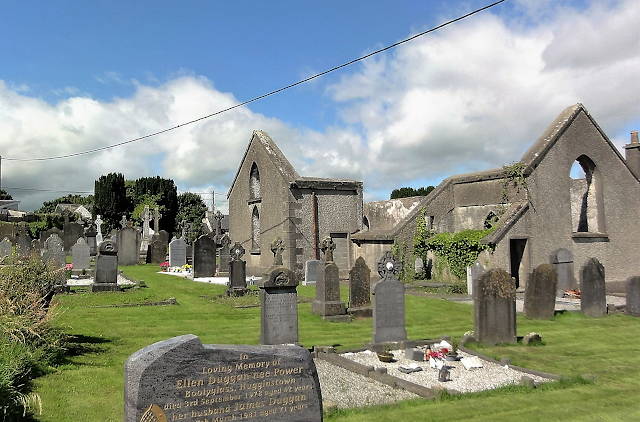
There are two graveyards in Hugginstown.  Bernie and I surveyed the old graveyard in June 2015.    Bernie took all the pictures.  This graveyard, which surrounds a roofless church, has 202 memorials; some families still have burial rights in the old graveyard so it can not be regarded as closed for further burials. The church, St Brendan's,  was built circa 1800 and was in use until 1983; it was preserved as a ruin in 2001.


The graveyard entrance is accessed via impressive 19th century wrought iron gates with flanking wrought iron railings.  The old graveyard is beautifully maintained. 


The newer graveyard, which is known as the Calvary Cemetery, will form a subsequent blog posting and had 74 memorials in September 2015; the earliest memorial in the new graveyard is dated 1986. 


The earliest burial in the old graveyard as marked on a memorial is 1810, closely followed by 1814, 1817 and 1819.   There are six memorials bearing dates for the 1820s and 18 memorials bearing dates for the 1830s; these include four memorials with the date 1832 which was the year of the cholera.  There are only ten stones with dates for the 1840s and four stones bearing dates for the 1850s.  There was a fashion for some of the older memorials, particularly for the 1840s period, to have "supporter" stones to the left and right of the main stone, usually just carved with a cross and the initials of the erector of the main headstone; some of these have been removed from their "parent" headstone or have been replaced with one facing east and the other facing west.  This fashion for "supporter" stones can also be seen in Knockmoylan, another Catholic graveyard in the area.   There is a strong continuity of names in both the old and the new graveyard. These are Catholic burial grounds.


A very Catholic symbol, the Lamb of God, decorates this fairly late stone. The carving of the inscription is not of the best.  Look at the wobbly W of who and the  varying depth of the cutting of the letters. Still it is decorated with sprays of shamrock.  The hand that carved the Lamb of God is probably not the same hand that carved the inscription.


There are eleven memorials with poems and verses inscribed on the back of the stones; the majority of these memorials usually date from the 1830s with 2 dating from the 1840s just before the advent of the Famine. Another 2 memorials with poems on the back date from 1838 and 1854 and were sculpted by members of the Beck family of Thomastown.  Inscribing a poem or verse on the back of a memorial would cost the erector extra money and expense.  This would seem to indicate that some of the strong farmers around Hugginstown were not that short of money at the time.  Verses, or versions of verses, are copied from stone to stone or indeed from one graveyard to another in the area.
A beautifully carved verse on the back of No 6, a Holden of Hugginstown stone. Note the term "yous" and the ornate frame around the verse. The carving has been there since circa 1836.  This memorial commemorates members of this same family from 1814 until 2010.


Fairly standard verses are "Stay passengers, see where I lie, as yous (sic - this would have been exactly how this word was pronounced) are now so once was I, and as I am now so yous will be, so think on death and pray for me"  or  " Stand by dear friends, wipe off your tears, Here I must remain until Christ appears, and when He comes I mean to rise unto a life that never dies"


An unusual forged  iron Celtic cross inscribed Mrs Mary Moore, July 3rd 1916 aged 75 years. Dunnamaggan. RIP. The name of the blacksmith who made this memorial is unknown.


Index to names on the memorials
Aylward, Baldwin, Barden, Barron, Barry, Bolger, Bowe, Brenan, Brennan, Brett, Burke. Butler, Buttler, Byrne, Callanan, Carroll, Cassin, Cleary, Cloony, Cochlan, Cody, Comerford, Conway, Costello, Creamer, Cuddihy, Culleton, Dalton, Daniels, Darmody David, Deegan, Delahunty, Donovan, Doran, Dorney,  Dowling, Doyle, Dray, Drea, Duggan, Dungan, Dunphy, Dwyer, Egan, Farrell, Feehan, Fitzpatrick, Fitzgerald, Flinn, Foley, Forristal, Fowley, Gash, Gaule, Geary, Gorman, Grace, Grant, Ginsell, Irish, Haassey (sic), Hayes, Halloran, Hanrahan, Healy, Hearne, Heneberry, Henebery, Henebry,  Hewitson, Hickey, Holden, Jackman, Jordan, Joyce, Keaneally, Kearns, Keating, Kelly, Kennedy, Kennelly, Kenny, Kinsella, Laherty, Lahey, Lahy, Larkin, Lee, Lonergan, Long, Lonrigan, Loughlin, Lyons, Macauley, Mackey, Maher, Malone,  McBride, McCarthy, McGrath, McKenna, Millea, Moloney, Monahan, Moore, Moran, Morriss, Morrissy, Mulcahy, Murphy, Nary, Neill, Nolan, O'Carroll, O'Driscoll, O'Dwyer, O'Farrell, O'Gorman, O'Hanrahan, O'Keeffe, O'Leary, O'Neill,  O'Shea, Phelan, Power, Purcell, Quann, Rafter, Reid, Roche, Rochford, Rohan,  Ryan, St Leger, Scurry, Shea, Sullivan, Suttie, Tennyson, Thompson, Tobin, Touhy, Tovey, Treacy, Wall, Wallace, Walsh, Walshe, Whelan.


This stone is unusual for being completely in Irish; most stones are in English with a smattering of latin such as phrases like Requiescat in Pace.  This stone translates "Remember Michael O'Halloran, Teacher at Moonrue School and originally from the grey stone church of Cork City; he died in the month of May 1948 aged 82 years. Also Maire Eileen Dalton died December 1957 aged 12 years. His wife Brid died 14 December 1979".


Index to places mentioned on the memorials
Aghavillar, Aughavillar, Australia,  Ballaugh, Ballintee, Ballinteskin, Ballybooden, Ballybray, Ballyteskin, Ballygerdra, Ballygowan, Ballygown, Ballyhale, Ballyknock, Barnadown, Barristown, Baysrath, Birmingham, Blackbog, Boolaglass, Bollyglass, Brownstown, Callan, Carrickathnaw, Carrick at naw, Carrickatna, Carrick on Suir,  Carrickshock, Carrigeen, Castlebanny, Castlemorris, Castle Park, Catstown, Cattstown, Cherrymount, Colemore, Condonstown, Coolmore, Cork, Corrickshock, Cotterstown, Croan, Curragh Camp, Cyprus, Dublin, Dungarvan, Dunhill, Dunnamaggin, England, Gorue, Gorrue, Gowlawn, Gracedieu Rd, Grannagh, Hugginstown, Jerpoint Abbey, Keatingtown, Kilcasey, Kilkeasy, Kilcurl, Kildare, Kileavaw, Kilkenny, Knockmayland, Knockmoylan, Knocktopher, Kyle, Kyleva, Leicester, Lismatigue, Liverpool, Lower Hugginstown, Luke Wadding St,  Mabbitstown, Milerstown,  Monroe, Moonrow, Moonrue, Moonrough, Mount Juliet, Mullinavat, Mullinahone, Mylerstown, Newmarket, NSW, Old Court, Piltown, Powers Hill, Redgap, Roanmore Dairy, Sandpits, St Brendan's Church, Sheepstown, Stoneyford. Sydney, Thomastown, Tinvaun, UK, USA, Waterford, Westmoreland.


It is very interesting to examine the non standardised spelling of some of these place names.   Carrickathnaw, is also spelt Carrick at naw and Carrickatna.   Kyleva is also recorded on the memorials as Kileavaw, which is exactly how it is still pronounced but the unprepared might think it a completely different place.  The same can be said for Boolaglass and Bollyglass (actually the same place) and Monroe, Moonrow, Moonrue and Moonrough (again all the same place).  


Index to Masons who have carved stones in this graveyard
B & N Ltd., John St,,    Richard Beck of Thomastown,   Thomas Beck of Thomastown, 
J.Bergin, John St, Watd,    Gargan,     Gargan of Kilkenny,    Gargan McDonald of Waterford and Carrick on Suir,     Gready of Kilkenny,     Hoban of Kilkenny,   Kean of Watd,    Kennedy of Waterford,   Molloy of Callan,    Molloy of Callan and Dungarvan,    Mullan of Kilkenny,   O'Donnell of Philip St, Watd,    O'Donnell of Waterford,      O'Donnell of Waterford and Carrick on Suir,   O'Keeffe of Newgate Waterford,   O'Keeffe and Sons,    O'Keeffe and Sons, Waterford,           P O'Keeffe, Watd,    R. O' Keeffe, Watd,   O'Shea, Callan,    Michael Shea of Mullinahone,   White of Carrick on Suir. 
These spellings are exactly as recorded on the memorials. Watd seems to be the agreed abbreviation for Waterford.     Being so south in the county of Kilkenny, people here are looking towards Waterford City or Callan for their masons but a good few are also travelling as far as Carrick-on-Suir, Tipperary and even Mullinahone in Tipperary to acquire their memorials.  There would, of course, be a reason for travelling as far as Carrick-on-Suir or Mullinahone, Tipperary for a memorial to be made and this might well be wrapped up in the family history.


Very fine and deep carving on a signed stone by Richard Beck of Thomastown. The entire scroll reads "Gloria in Excelsis Deo".   Note the angel with feathered wings; the angel represents the soul of the person commemorated by the stone flying away to Heaven. If you look carefully you will see two little legs amongst the feathers as if the soul is hovering between this world and the next before flying away. This memorial was erected by Edmond Power of Condonstown in memory of his daughter Elenor Power who depd (departed) this life June the 22nd 1838 aged 10 years. Also his father David Power who depd this life 26thJune 1814 aged 67 years.  On the back it reads " I am dead and sleeping here. RIP".


The new Catholic church,  known as The Holy Trinity Church is on the opposite side of the road.
There is a commemorative memorial immediately outside the graveyard on a wall to the right of the entrance. 
Commemorating the War of Independence 1916-1921


Thursday, 28 July 2016

Description of the funeral of Mr Philip Aylward, Knockmoylan, 1867

In keeping with our wish to record and collect funeral traditions for county Kilkenny, the following description of the funeral of Mr Philip Aylward of Knockmoylan, in south county Kilkenny, makes worthy reading.  The description is taken from The Kilkenny Journal for Saturday February 16th 1867 but this funeral was also reported in The Carlow Post 23rd February 1867    Philip Aylward, a Catholic, would fit the category of "strong farmer"; that is a man of some substance, a good few acres and well respected within the community. He was the son of Richard Aylward (died 1854) who was described as a wealthy and respectable farmer. His mother was Bridget Brenan who died in 1832.  It is said the whole family was noted for its great piety and natural talents of the highest order.(Carrigan -  History and Antiquities of the Diocese of Ossory 1905).


"It is our melancholy duty to record the death of Mr Philip Aylward of Knockmoylan.  He expired at his residence on Sunday evening the 10th last,  after an illness of some duration.  His death has cast a gloom over the whole parish where he lived and where his virtues were so highly apparent.  He had many of those noble traits which showed so conspicuously in the character of the late pastor of Castlecomer, his illustrious brother.  He had a large and generous  heart and was foremost in every work of religion and charity.  Gentle as a child in the midst of his family, he was a good Christian, a kind husband, an exemplary father and munificent in his charities, and the number who attended his funeral from distant parts of the country gave ample proof how sacred were the ties that bound him to his numerous friends.  He has left a disconsolate widow and a young and interesting family to mourn his loss.   The solemn requiem offered for the repose of his soul was celebrated in the neat little rural chapel of Knockmoylan last Thursday, the Very Rev. Dr Walsh, PP (Parish Priest), of Slieverue presided and the Ven (Venerable) Archdeacon O'Shea, PP of Ballyhale was the celebrant at the High Mass.   There were two chanters, Rev Fintan Phelan, CC (curate) at St Canice's and Rev Joseph Dunphy, CC at St John's and 45 other priests.    After the Mass, the absolution was given.  Then the coffin containing the remains, which was covered with a black cloth, richly mounted and bearing the inscription "Mr Philip Aylward. Died the 10th of Feb 1867 aged 56 years"  was taken from the catafalque. The 45 priests, proceeded by the cross bearer and acolytes, formed a procession two deep and proceeded round the cemetery singing the Benedictus till reaching the grave where the Archdeacon, habited in a black cope of silver tissue, performed the funeral service.   The scene was most impressive as the procession moved round the burial ground - the silence of that lonely spot, the long line of white robed priests, the mournful cadences of the solemn chant were touching in the extreme and the air was soft and balmy as June. Requiescat in Pace"


This was obviously a very impressive funeral.  The newspaper names all the priests attending the funeral but I can't quite add them up to the number of 45 priests said to be in attendance.   Probably the reporter did not get all the names but the priests and curates came from Aughavillar, Ballycallan, Ballyhale, Callan Castlecomer, Danesfort,  Dunnamaggin, Innistioge (sic), Kilmacow, Knocktopher, Mooncoin, Muckalee, Mullinavat, Rosbercon,  Slieverue, Templeorum, Thomastown, Waterford, St Canice's, St Johns and St Kyran's College all last three in Kilkenny city.   And one priest, a Rev James Darcy, whose address is given as New Jersey, North America.


Philip Aylward's  uncle, the Rev William Aylward (died1832) was a priest. His brother Rev Edward Aylward (died 1865) was parish priest at Castlecomer, as referred to in the above newspaper report.  During the Famine years he held Tenant Rights meetings in Castlecomer and was one of the original members of the Council of the Tenant League. Another brother Patrick died when a sub-deacon aged only 24 years.  His brother Thomas (died 1861) became a Christian Brother and his two sisters, Mary (died 1867) and Margaret (died 1880) became nuns in the Presentation Order convent in Castlecomer.   Three of his Brenan uncles were also priests.   It is hardly surprising that there was such a huge turnout of priests at this funeral.


Philip Aylward married in 1845 Catherine, daughter of Edmond Fitzpatrick of Kilcready.  She died in 1905.   According to my records they had 12 children, 7 boys and 5 daughters.   Three of these children, Thomas, Margaret and Katie,  pre-deceased him and are also buried in Knockmoylan graveyard.  That left nine children for the widow to care for, presumably the "young and interesting family" described in the newspaper report.  We have never before seen the word "interesting" applied in this way and wonder exactly what the reporter meant by using this term.   Probably we shall never know........

Sunday, 3 July 2016

Dunnamaggan Graveyard, Parish of Dunnamaggan, county Kilkenny

Dunnamaggan graveyard gives the impression of being untidy and not that well kept although the front section, which is the newest section and nearest to the road, is well maintained.  The older section of the graveyard, behind the ruined church, is confusingly laid out. There are piles of broken stones around the ruined church which makes walking hazardous and several pieces of broken 19th century coffins handles lie on the open ground.


We visited the graveyard in 2009 and again again in 2010 and 2011 in order to complete the transcriptions and mapping.  In all at that time we found 98 memorials or memorial plots but it is important to bear in mind that this graveyard is still in use.   The graveyard is large being very long but not very wide. At the far end of the graveyard is a small rath or circular enclosure about 8 feet in diameter.  Carrigan (History and Antiquities of the Diocese of Ossory) suggests it might be the remnants of a hermit's cell.    The small ruined church is dated to the last years of the 12th century or the beginning of the 13th century.  St Leonard is the saint venerated here with a holy well and St Leonard's bush; emigrants leaving Dunnamaggan would take a sprig of the bush away with them as protection against ship wreck.  Similarly during the cholera epidemic of 1832 local people carried around little scraps of the bush to save themselves from the epidemic. Although the memorials do not record exactly what caused people to die, three people are recorded as dying when the cholera epidemic must have been at its most rampant.  These are a lady "Ellen Tobin alias Quinlan who departed this life the 8th May 1832 aged 84 years" and her grandson "John Tobin who departed this life the 8th January 1833 aged 1 and a quarter years" (No. 23) and "Patt Cass, brother of John Cass of Callan who died 5th January 1832 aged 22 years" (No. 94).


This is a very old Catholic graveyard.  Within is a ancient Celtic Cross which belong to the period 1050-1200AD.  This cross is decorated with five carvings of human figures; one of these represents a figure of a bishop or abbot in vestments and with a crozier; another represents a female saint, probably St Catherine with her wheel.    It is allegedly the resting place of one of the seven bishops treacherously done to death on the instruction of Margaret FitzGerald, countess of Granny Castle. The Legend of the Seven bishops is well known in Kilkenny but it was already an old story during the lifetime of the said Margaret Fitzgerald who died in 1539.


Apart from the Celtic Cross, the earliest memorial is dated 1750 with a further ten stones dating from this last half of the 18th century.  Thirteen stones date from 1802 - 1820 and six stones date from between 1827-1839.  There are three stones dating from the 1840s and a further four memorials dating from the 1850s.  


List of surnames inscribed on the memorials
Barry, Behan, Bergin, Brennan, Broderick, Bryan, Burke, Butler, Cahill, Cass, Clooney, Comerford, Condon, Corcoran, Costello, Costigan, Crealy, Croake, Cudihy, Danielly, Davis, Dawson, Deacon, Delany, Dempsey, Doyle, Dunne, Fahy, Fennely, Fitzpatrick, Fleming, Foley, Foran, Forristal, Funchion, Glendon, Grace, Grant, Green, Griffin, Hanrahan, Hawe, Heads, Hearns, Henebry, Hennesy, Hewetson, Holden, Hoyne, Hughes, Johnstone, Kavanagh, Keane, Keeffe, Kennedy, Kenney, Lahart, Lahert, Lannen, Liddiard, Long, Lynch, Maher, Marnell, McBride, McDonald, Meny, Millea, Moore, Morrissey, Murphy, Neel, Nores, O'Brien, O'Donoghue, O'Gorman, O'Keefe, O'Neill,  O'Shea, Peters, Peeters, Phelan, Pollard, Poor, Power, Purcell, Quinlan, Ragget, Roe, Rowe, Ryan, Sexton, Shelly, Stapleton, Tenison, Timon, Tobin, Vennard, Voss, Wallace, Walsh.
List of places named on memorials
America, Archer St, Kilkenny, Ballintee, Ballyhall, Ballytobin, Baurscoobe, Bawscoobe, Belgium, Caherleske, California, Callan, Churchtown, Dublin, Coolmore, Croan, Danganbeg, Danganmore, Delaware, Dunnamaggan (various spellings), Dunnamaggan West,  Fermoy, Garranrobin, Goodwinsgarden, Johnswell, Kells, Kilkenny, Kilmoganny,  Kilree, Knocktopher, Lacken, Ladyswell,  Lijsshenthock Military Cemetery, Loughbrack, Mallardstown, Monaussa, New Road, New South Wales, Newtown, Passage, Rathculbin, Rathduff, Readsbarn, Rockhall, Rossenara, Sheepstown, Shortalstown, Stoneyford, Tinvaun, USA, Vinesgrove, Waterford.
There are some very moving memorials here. One is a memorial on the boundary wall above a Marnell of Dunnamaggan burial plot.


This reads " In memory of Walter Marnell 1st Battalion Irish Guards who sacrificed his life at the Battle of the Somme on 1st July 1916 aged 22.  His body lies in Lijsshenthoek Military Cemetery, Belgium. A beloved son of John and Catherine Marnell of Dunnamaggin.  Lest we forget.".    Guardsman Walter Marnell volunteered for The Irish Guards at Ormskirk, Lancashire, after the outbreak of the war and was shipped to France on 25th May 1915.   He died of his wounds on the first day of the Battle of the Somme.  Lijsshenthoek Military Cemetery is at Poperinge in West Flanders, Belgium.   As it happens it is 100 years since he died on the Somme and that is a very sombre thought. 
Another interesting memorial is attached to stone No. 44. "Erected by James Purcell in memory of his mother Bridget Purcell alias Rowe, Dunnamaggan who died 11th September 1859 aged 55 years. Also of her mother Mary Rowe alias Bryan who died 4th April 1860 aged 82 years and her uncle David Rowe who died 4th October 1868 aged 85 years.  From where the Delaware flows, Neath foreign skies, A sons poor tribute marks, Where his mother lies, And suppliant asks, From the far distant West, Old neighbours prayers, for her eternal rest".    There is a lot of genealogy on this one stone for anyone related to this family and the poem is unique.  We know exactly where James Purcell is in America.   But this stone also represents the deep rooted desire of many emigrants who have made enough money in their new country of residence to record, back in Ireland, the last resting place of their parents and relations.   There can't be a graveyard in the whole of Kilkenny county that does not have a similar memorial erected by an emigrant son or daughter (but not necessarily with a poem).   They are, perhaps, providing the dignity of a headstone or memorial for a family that previously may not have had the resources to erect a memorial but, as is the case here, the son has made it good in America and this is the last thing he can do for his mother.   It is like a determination to mark the spot that belongs to them, probably their traditional burial place.   It is interesting, though, that he makes no mention of his father; I wonder what the story is there?
Finally a shocking and terribly sad memorial of a large Celtic Cross  "Erected by Matthew Walsh in loving memory of his son Patrick, Captain in the IRA.  He was wounded by the British and taken to Fermoy where the amputation of his leg without anaesthetics caused his death 18th May 1921. May his soul rest in peace Amen".    Patrick Walsh was born in Dunnamaggan in 1887 and became a member of the Gaelic League and the Gaelic Athletic Association  and later a member of the Irish Volunteers.   On a morning in May 1921 he was severely wounded during an engagement with British forces at Knocknagress, Tullaroan, county Kilkenny and taken initially to the Kilkenny Military Barracks but later transferred to Fermoy Military Hospital where his leg was amputated.  He was Captain of B Company, 8th Battalion, Kilkenny Brigade.


Friday, 1 July 2016

Knockmoylan Graveyard, Parish of Ballyhale, county Kilkenny

Knockmoylan, in the catholic parish of Ballyhale, lies on the old Kilkenny to Waterford Road midway between Ballyhale itself and Mullinavat.  This is strong Walsh territory edging as it does on to the area known as the Walsh Mountains. At one time the entire townland of Knockmoylan belonged to the Walsh family.   The church at the centre of this well maintained graveyard was built in 1812 and is known as All Saints Catholic Church. The graveyard is still in use.   Despite the 1812 date for the church the earliest memorials in the graveyard date from 1832 and 1833; there are 7 memorials dating from the 1840s and another 7 dating from the 1850s.


There is evidence of very fine stone engraving and carving dating from this early period.  In all there were 84 memorials, or memorial plots, in the graveyard which was surveyed in 2010.   Knockmoylan can be spelt as Knockmoilan and Knockmoyland.  The spelling of place names on the memorials can be very inconsistent such as Crobally, Crolybally and Crowbally  And as per as usual here in Kilkenny there is at least one stone, erected by an exile in a foreign land, as a memorial to parents and family at the traditional family burial place.  Also evidence of the useful practice (for family historians) of recording on a headstone those members of the family who have died overseas.

Table top tomb erected by Mr Richard Aylward of Knockmoyland to his son Rev. Patrick Aylward who died in 1859 aged 24 years.  


Index of names
Aylward, Anderson, Bowe, Brenen, Cain, Cantwell, Cashin, Cass, Cassin, Coady, Collins, Dalton, Darmody, Darmedy, Dermody, Dempsey, Doherty, Doody, Doyle, Dunphy, Drennan, Dywer, Fitzgerald, Fitzpatrick, Fleming, Grannan, Grant, Hanrahan, Healy, Hogan, Holden, Holehan, Holohan, Hurley, Jones, Kearns, Kelly, Kenneally, Lawlor, Mackey, Madden, Maher, Malone, Mason, McBride, McCarthy, McDonald, McGrath, Moloney, Morrisey, Morton, Murphy, O'Brien, O'Dwyer, O'Neill, O'Shea, O'Sullivan, Phelan ,Power,  Raftice, Reade, Reid, Reilly, Rocket, Ryan, Sullivan, Walsh, Walshe, Wemyss, Whelan.
Index of places mentioned on the memorials
America, Australia, Ballinabola, Ballybray, Ballybrushen, Ballytarsna, Ballytarsney, Barnsley, Brighton. California, Castlebanny, Castlegannon, Chicago, Clanassy, Cooleraheen, Coolmean, Coolmeen, Coolroemore, Cor......(illegible), Cottierstown, Cotterstown, Crobally, Crolybally, Cross Gates, Crowbally, Derrylackey, Dunboyne Establishment, Glendonnell, Gorrue, Kilcready,  Kilkeasy, Kilkenny, Kilkenny county, Kill, Kiltorcan, Knockmore, Knockmoylan, Knockmoyland, Knocktopher, Legan, Liverpool, Lukeswell, Maynooth, Mullinakill, Mullinavat, Newchapel, New Zealand, Rosboultra, Sacremento, St Kyran's College, South Australia, Sussex, Thomas St, Thomastown, USA, Waterford, Waterford city, Waterford county, Yorkshire.
Index of Stonemasons
Being so near Waterford city it is not surprising that some people erecting memorials have looked towards Waterford rather than Kilkenny for their stonemasons.  These Waterford masons  are:-  Flynn of Waterford,   Patk Kenny of New Street, Waterford,   O'Donnell,  Phillip St, Waterford,   O'Keeffe and Sons, Michael Street, Waterford. Other masons are Molloy, Molloy of Callan and  O'Shea of Castlebanny. 
Knockmoylan graveyard has several examples of older upright stones with what might be described as small "supporter" stones immediately to the left and right of the main stone.  These side "supporter" stones are usually just carved with a cross and the initials of the erector of the main headstone.  It is reminiscent of "supporters" used either side of a heraldic device.  This style of "supporters" to the main memorial seems to become popular in the 1840s and does not survive much beyond the 1850s and is evident elsewhere around the area in catholic graveyards such as at Hugginstown;  it does not seem to be practiced by those of the Protestant faith.   Having such "supporters" would have added expense to the erection of the main headstone.    No 39 on our list "Erected by John Fleming of Ballybrushen in loving memory of his beloved wife Elizabeth Fleming alias Phelan who depd (departed) this life Aug 25th 1842 aged 45 years" has just such "supporters" to the left and right of the main stone and marked simply  "JF".
No 30 on our list above, a beautiful old and lichen encrusted stone "Erected by the Widow Aylward of Lukeswell in memory of her husband John Aylward who departed this life December 17th 1849 aged 71 years". Her sons Thomas Aylward and Edmond Aylward are also mentioned on the stone but there are two "supporters" on either side of the headstone simply marked WA (standing for Widow Aylward).    This is a rare example of a woman erecting "supporters" as usually we have found they are erected by a man.    Such "supporters"  which have become separated from their main headstone, for example during a burial when things get moved around,  can confuse people into thinking they are independent headstones but this is unlikely to be the case.
Another such headstone with "supporters"on either side simply marked on each supporter JM, is No 5 on our list which reads "Erected by James Murphy of the city of Waterford in memory of his father John Murphy of Ballinabola who departed this life 25th June 1841 aged 60 years".


There is one First World War memorial which is in the burial plot of the Ryans of Castlegannon (No 29).  This is to 160891 Sapper P Ryan, Royal Engineers, who died 6th November 1918.

Saturday, 18 June 2016

A Kilkenny Funeral Entry 1639 for the family of Merry alias O'Houlaghane of Callan

Found accidently whilst leafing through a volume The Memorials of the Dead 1907  was a transcription of a Kilkenny Funeral Certificate dated 1639 for the family of Merry or O'Houlaghane of Callan.   What you may ask is a Funeral Certificate?  The Funeral Certificates of Ireland date from 1588-1729 and are to be found in the Genealogical Office in Dublin with the exception of one volume which has ended up in the British Library in London.  These certificates contain a return of names, parentage, arms, marriage, issue, and date and place of burial of the Irish gentry whose funerals where officially attended by the Ulster King of Arms or his deputy.  They are a kind of early death certificate but for the gentry only.   Nevertheless they are extremely useful.   This Merry/O'Houlaghane funeral certificate reads as follows:-


Thomas Merry alias Houlaghane of Castle Town in the County of Kilkenny, eldest son of Richard Merry of Callen in the said county, deceased.  The first mentioned Thomas took to his first wife Juan (Joan?) daughter of (blank) Harris of (blank) by whom he had issue.  The first mentioned Thomas took for his 2nd wife Mary daughr of John White of Kells in the county of Kilkenny, Gent by whom he had 2 children, one son and one daughter, viz Richard Merry, the son and Margarett the daughter both young and unmarried.  The said  first mentioned Thomas departed this mortall life at Castletown aforesaid the (blank) of Novemr 1638 and was interred in Our Ladies Church, Callan aforesaid.  The truth of the premisses is testified by the subscription of Pierce als (alias) Peter Merry cozen of the defunct who hath returned this certificate to be recordd in my Office, taken by Thomas Preston Esqr, Ulvester (Ulster) King of Arms, the 9th of May 1639.  (All spelling as in original document).


This funeral entry states quite clearly that Thomas Merry, alias Houlaghane, was buried inside St Mary's Church, Callan.    Carrigan (The History and Antiquities of the Diocese of Ossory 1905) records the following floor slab, then being used as a doorstep in the north entrance to the nave of this church. (This appears in Vol  3, page303,  and is in the section where he is describing the North aisle).    The floor slab is in latin but translated reads "Here lies the distinguished man Richard Merry formerly..........................notary, who happily exchanged life for death Dec 27th 1584".  Carrigan states that the inscription is in Old English lettering, in part, worn away but that there was a cross in relief down the centre. He found no mention of Thomas Merry of the Funeral Certificate dated 1639. 


The north entrance to St Mary's, Callan


Further research records that the Celtic family of O'Hoolahan (sic) was disposed of its territory in Connaught in the 16th century when members of the family settled in various parts of Leinster changing their name to Merry, MacMerry or Fitzmerry.  A Richard Merry alias Hoolahan of Callan  received a pardon June 10th 1559 - this is no doubt our man of the doorstep tombstone dated 1584.


Thomas Merry of the 1639 Funeral Certificate was without doubt an important man around the town of Callan.  The Sources database at the National Library of Ireland has manuscripts recording his land deals from 1593 - 1631.   He was clearly a man of substance so it is odd that no memorial to him has survived at Callan.   One 1593 grant to Thomas is for a castle and messuages in Callan, another 1595 grant made by his cousin John Merry is of 2 messuages and a garden in Carrickmagiffin; this is now called Carrick on Suir and is in Tipperary.  Further grants to Thomas Merry concern land in Callan called Andrew's Croft (1604), a grant of a house and garden in Kells Street made during the time of James 1, a 1613 grant by Donogh Dologherty for his brother-in-law Thomas Merry alias Hologhan, of 2 messuages and garden in Callan.  He also gets a grant in 1601 for land at Skehanagh in the borough of Callan for 61 years.  And a lease for the Manor of Callan for 21 years from December 10th 1613.     There is a lease given to Thomas Merry by the Earl of Ormonde for the lands of Castletown, county Kilkenny for 21 years dated September 1605 and another lease from Viscount Thurles to Thomas and Mary Merry of the lands of KilmcOliver, county Kilkenny and of Cerry in county Tipperary given in May 1631.     Clearly Thomas Merry is an affluent  man of property.    Some of the children of Thomas Merry settled in Waterford where is it possible to trace them up to comparatively modern times.    One of the direct line of descent, a John Merry, married Mary Murphy of Waterford; they had two sons, Joseph and John Peter and a daughter Mary.  Mary married Robert Power, Waterford merchant.   Joseph(died 1804)  went off to Seville in Spain where he became a merchant, married  a Manuela Gayte and had 5 sons and two daughters.   John Peter Merry (born 1745) went to live in London where he too operated as a merchant.  He never married but his 1804 Will (in the National Archives in London) reveals that he had a natural son by Rebecca Buton, a house servant formerly in his employ.  The son, George Merry  born 15th June 1791, "now at Mr Turner's School in Hammersmith" is well provided for in his Will as is the mother of the child with the caveat "she shall not interfere with my son".    The Hammersmith and Fulham Archives in London possess a scrap book which had been compiled by a Captain George John Thomas Merry  (born 1817) and who was the son of George Merry (born 1791).    It is possible to trace the line down further.


Mary Merry who married Robert Power of Waterford, left in her Will a bequest to establish a Ladies Asylum in Waterford for 12 old ladies who found themselves in reduced circumstances.   She named as her trustees Rev Dr John Power, Bishop of Waterford and Edmund Rice, the founder of the Irish Christian Brothers.  However one of her Spanish nephews, a Joseph Merry came to Ireland to lay claim to her money and dispute her Will.  The dispute was heard in the Spiritual Court: John Philpot Curran, the Master of the Rolls made the judgement against Joseph Merry and upheld the bequest in Mary's Will.


There is a draft pedigree for this Merry family in the Genealogical Office collection, Dublin; this refers to the Merrys of Waterford and of Seville in Spain.   And an article on the Waterford Merrys  in The Journal of the Waterford and South East of Ireland Archaeological Society.  Vol XVI. pp 30-35. 1913.
The following Merry families must also descend from the wider Merry family in Callan:-


1. A memorial transcribed by the Callan Heritage Society in 2005 in St Mary's.  A large flat stone.

 "Here lies deposited the remains of Bridget Merry alias Cody with two of her children. She died 13th June 1819 in the 33rd year of her age. Also the remains of her son John Merry who died 2nd May 1824 aged 12 years.  Also the remains of her husband Michael Merry of Callan who dept (departed) this life 7th May 1825 aged 48 years".


2. In Old Kilbride Graveyard on the southern outskirts of Callan is the following headstone:-
"Erected by Patrick Merry in memory of his wife Bridget Merry alias Costigan  who died July 8th 1805 aged 30 years". (Kilbride Graveyard has been transcribed and published in The Irish Ancestor No 1, 1986).


3. In Kells Priory we recorded a broken Merry headstone: only part of a formerly upright stone remains and this reads:-
 "........................Merry who departed Aug 18 1722...Erected by Pierce Merry her son who died ye 20....................Also Walter Merry her husband 1738".   Sadly the part of the stone naming Pierce's mother who appears to have died in 1722 is no longer to be seen around the Priory.  The remaining wording is tantalising though.  

Broken Merry headstone at Kells Priory dating from 1722


There is a prerogative Will dated for 1639 for Thomas Merry, alias Halligan (sic) of Callan, county Kilkenny in the Index to the Prerogative Wills of Ireland (1897) and two Wills in Ossory Wills 1536-1800 (1909) for Thomas Holaghan als Merry of Ballinecrony, county Kilkenny dated 1693 and for William Holaghan alias Merry, Kilkenny 1719. This last Will is for a cleric: Rev William O'Holaghan of the city of Kilkenny who made his Will in 1719 and who died in the same year.


Wednesday, 15 June 2016

Kilkeasy Graveyard, Parish of Aghavillar, county Kilkenny

Kilkeasy Graveyard lies down a back road between Hugginstown and Ballyhale.   It is beautifully situated on slightly higher ground than the surroundings and even when there is not a breathe of air down on the roadway, there always seemed to be a little breeze within the graveyard to blow away all the miasmas.  There is one elderly tree in the graveyard, a sycamore, which always seemed to be rustling its leaves at us when Bernie and I surveyed this graveyard in June 2014.


Kilkeasy can be spelt in various ways including Kilkasy, Kilkeasy, Kilcasey, Kilcacy, Kilceacy and Kilkeacy.   The graveyard is enclosed by a stone wall and has a ruined church which dates from prior to the 12th century. There are exactly 40 inscribed stones or distinct memorials.  This is an ancient burial place with inscribed  stones dating from the 18th century;  the earliest stone dates from 1735, others from 1769, 1775, 1786, 1789, 1792, and 1798.  A further 10 memorials date from between 1802- 1822.   There is one fairly modern stone which reads "Pray for the soul of Thomas Phelan who was killed at the Battle of Carrickshock 14th Dec 1831. Rest in peace".    In addition there are about 90 unnamed stone grave markers.  This is a Catholic graveyard.  Kilkeasy had 612 inhabitants in 1837.


Index to names


Aylward, Bomers, Bowers, Brennan, Brophy, Burke, Carroll, Costelloe, Costelo, Dalton, Dugan, Dugin, Egan, Farel, Farrel, Farrell, Fleming, Fitzpatrick, Gee, Hayden, Holden, Kealy, Lawlor, Mackey, Maher, Mason, McGrath, Murphy, Phelan, Power, O (just initials M.O), O'Farrell, Roche, Shachy, Walsh.


Index to place names recorded on memorials

Ballinaraha, Ballybray, Ballybrishen, Ballyflough, Ballyknock, Ballylock (possibly Ballyflock), Ballynacooly, Blackditches, Boolyglass, Boullaglass, Carrick-on-Suir, Carrickshock  (Battle of),  Corbally, Cottierstown, Goodwinsgarden, Harristown ,Hugginstown, Kilcacy, Kilcasey, Kilceacy, Kilkeasy, Kilkenny, Kilkenny county, Killahy, Knockmoylan,  Knocktopher,  Lacken, Melbourne, New Park, Pleberstown, Upper Patrick St.


Index to names of the mason inscribed on memorials

Wilm Kearney,   Molloy of Callan,  Molloy of Callan and Dun(garvan),  Molloy of Callan and Tullaroan. 


Stone No 27 is a collapsed altar stone now standing on raised pillars which are placed lengthways and not upright.  It was very difficult to read with a lengthy and flowery eulogy taking up most of the entire top of the stone "Beneath are interred the remains of Mrs Bridget Walsh alias Hayden in whose memory this monument has been erected by her husband Mr Wm Walsh of Kilkacy.  In the character of this truly amiable woman was combined those brilliant and attractive qualities of heart and intellect that never failed to impress her acquaintances with a sense of her superior merit and eminent virtue. Nature that endowed her with a penetrating and comprehensive a mind which industry improved and enriched by acquisition of a considerable fund of useful and ornamental knowledge.  It is too little to say of her, that this wife, parent, neighbour and in all virtuous (possibly various?)  relations of life she endeared herself with a blameless image.  She possessed a suavity (possibly surety?) of manner and goodness of heart and a benevolence of disposition that merit more exotic praise. She passed from this life to a better life on 18th Nov 1822 aged 45 years, accompanied by the acclaim of good works, lauded with the benediction of numbers whom her charity relieved and succoured, lamented by friends who her departure filled with sorrow and affliction.    Also the body of Will Walsh who died the 20th day of Jany AD 1858 in the 81st year of his age.  A husband worthy of such a wife"


There is quite a lot to say about this memorial.  First of all it was a very expensive memorial to erect and to have incised with such a long eulogy. This couple were comfortably off and quite keen to have their affluence displayed and acknowledged by the erection of such a memorial.  Their comfortable position in life is confirmed by the good works and charity dispensed by Bridget.  This memorial shows that they considered they had a certain privileged role in the society in which they moved and certainly William wanted to ensure this was recorded for posterity.  The use of the titles Mrs Bridget Walsh and Mr Wm Walsh (rather than just Bridget Walsh and William Walsh) indicates these were people of some substance and who took their position seriously.   Both husband William Walsh of Kilkacy and his wife Bridget Hayden were born in the same year 1777 but William survived Bridget by 36 years.    Presumably he did not marry again as there does not appear to be mention of a second wife but someone must have cared for him into his old age - one presumes a daughter or daughter-in-law.   The "penetrating and comprehensive mind which industry improved and enriched by acquisition of a considerable fund of useful and ornamental knowledge" and "superior merit" plus "blameless image" make this lady an absolute paragon of virtue.   The illuminating line however is the very last sentence which records William's death   "A husband worthy of such a wife".  In other words William was not outshone by his wife and she was worthy of him.  It is fairly unusual to find such a lengthy eulogy on a Catholic stone.  A descendant of this couple tells us that Bridget was a Hayden of Cahirleaske, a hugely respected Catholic family in the area. 
There are a further 9 memorials to Walsh here including three which have been erected by other Walsh of Kilkeasy.    These are "Erected by John Walsh in memory of his father David Walsh of Kilkacy departed this life 28th April 1786 aged 79 yrs" (therefore born 1707).   "Erected in memory of Mr John Walsh of Kilkeacy who departed this life Nov 22nd 1833 aged 86 yrs" (therefore born 1747) and a headstone to David Walsh of Kilkeasy died 25th June 1865 aged 90 years (therefore born 1778).  A nearby Walsh stone records "Edmd (Edmond) Walsh who died Nov 1735 aged 55 yrs (therefore born 1680).  This does not say of Kilkeasy but I suspect that Edmond Walsh was of this same Kilkeasy family.  In fact this is a very interesting family and worthy of more research.  For the sake of clarity I have not quoted the full transcription for these 4 Walsh stones but can check if you think these are your family.


There is another very damaged and broken Altar tomb which was really very difficult to read and gave us considerable trouble.


Trying to decipher the top of this stone using a torch to reflect the carving of the letters
It is split right across the centre. "Beneath this tomb (erected by?) James Farrell of Killahy are deposited the mortal remains of his beloved son Edmond Farrell of Killahy who departed this life the third day of December one thousand, eight (?) hundred and twenty six in the thirtieth year of his age". There follows four short lines of poem but this is almost impossible to decipher "He whom no help or prayers could save, From certain death or fear, May by piety of his life, Have all his........"   Here also lie the remains of Bridget Farrel (sic) of Harristown who departed this life February 11th 1818 aged 19 (?) years.
Finally just to amuse you,  a quote about the Mill at Kilkeasy (the mill at Cill Cess in Osraighibh) "it will not grind on the Lord's day except for guests, and will not grind even a handful that has been stolen; and women dare not to come into it".  (From Carrigan's History of the Antiquities in the Diocese of Ossory 1905. Vol IV page 6.)

Saturday, 21 May 2016

Rossaneny (Roscon) Graveyard, Parish of Windgap, county Kilkenny

Blink and it is easy to miss Rossaneny (also spelt Rossoneany) graveyard; the area is known locally as Roscon.   It is not easy to find even when you know what you are looking for.  This is a remote and very abandoned graveyard about a mile and a half outside Windgap on the Cotterstown Road.  There is no sign post, no gate and no obvious entrance as the way in is only guarded by a bit of string tied between two bushes and a bit of wood.   The intrepid Bernie took all the photos.


It is all very unkempt, overgrown and uneven underfoot.  There is a small ruined church on the site with a doorway in the middle of the south wall.  There is also a small primitive altar within the church ruins.  


The ruin can not be seen from the road; indeed the whole graveyard can not be seen from the road although in fact it is very close to the roadside.
Carrigan (History and Antiquities of the Diocese of Ossory, 1905) says there are only one or two inscribed stones in the graveyard which date from the beginning of the 19th century. We only found one inscribed stone and it dates from the last years of the 18th century.


This handsome headstone still stands erect.  It has a decorative IHS with a cross at the top of the stone, with a sunburst design and two ciboria or chalices on each side of the design; you can not see this fine carving work from the photo above as the weather is doing its worst.    The incised carving below the decorative top reads " God be merciful to the soul of Richard Murphy who depd (departed) this life the 19th June 1792.  Erected by his wife Margaret Murphy alias Kelly".
This headstone would have been expensive in its day.  It is carved from local limestone and is now covered with beautiful lichens.  We have used very finely ground cat litter to highlight the letters on the inscription to enable us to read them and a very soft brush to gently brush and blow away all the cat litter to restore the stone to its original state, leaving it as we found it.  The wording on the headstone is typical for a Catholic family at the time.
Apart from this one inscribed slab there are many uninscribed grave markers which record burials and mark the last resting place of unnamed, but no doubt loved, former residents of the surrounding area.


For those interested in their genealogy the nearby Windgap graveyard has the following two Kelly inscriptions which link to Rossaneny.  All spellings are as recorded on the stones
" Erected by Thomas Kelly of Rossenany in memory of his mother Catherine Kelly alias Quan who died in April 1847 aged 40 yrs.  His uncle Martin Quan died 1852 aged 70 yrs. Also Mary Quan alias Power wife of Martin Quan who died in July 1869 aged 80 yrs".
"Erected by John  Kelly of Rossenena in memory of his father Pierce Kelly who died Feb 21st 1843 aged 71 yrs.  Also his mother Catherine Kelly alias Hawe died April 30th 1847 aged 74 yrs".


Other memorials in Windgap graveyard which mention Rossaneny are for the names of Brophy, Downey, Mackey, Phelan, Prendergast and Ryan.   There is one Murphy headstone which mentions Rossenena but it is late (1960s).   There are two stones in Windgap  graveyard which mention Roscon as a place of residence; these  are for the names of Healy and Quan.